
Maybe I’m in the twisted minority, but I can never get enough first marathon stories. Before I ran my first marathon I must have read a hundred of them—the good, the bad, and the ugly—especially the ugly, because marathoners know there is nothing pretty about your first grueling 26.2, and I wanted to be prepared for the worst. As it turns out, all of my reading steered me towards a conservative approach to my race, so my story didn’t turn out too ugly (sorry, fellow tragic-first-marathon-story-seekers).
It’s been quite some time since my race, but I want to share it with you today because I’m just dying to jump back into the running world after my knee surgery, and after today’s follow-up with my surgeon, I’m feeling like the starting line might be in sight.
In the spring of 2017, I started researching possible races to give direction to my training after a nine month hiatus from running during my latest pregnancy. Naturally, I decided that would be an ideal time to train for my first marathon and subsequently registered for the St. George Marathon.
During the next 21 weeks, I slowly increased my mileage from 0, lost my 50 pounds of pregnancy weight gain, found a pair of shoes that finally didn’t make my right foot go numb (7th pair, stupid wide feet) and reached the peak of my training at a 20-mile run. Three weeks of taper later, I was ready to take the starting line.
Because my dad and brother were signed up for the race as well, my whole family planned to go down to St. George for the weekend. Friday night, we stopped at the Pizza Factory in Cedar City for some carbo-loading and then made our way to the expo for packet pick-up. After a quick stop at a gas station for a gallon of milk, we drove to the house my parents had rented for the weekend, hoping to hit the sack early—the 3:45 early bird bus was fast approaching. Our two- and three-year-olds, of course, had other plans after we tried to make them share the bottom bunk, so after we struggled to keep them quiet without waking the baby, I only managed to catch an hour and a half of sleep before my alarm went off. I put on my racing gear, nursed my seven-month-old, forced down a bowl of Honey Bunches of Oats, and headed out the door into the night.
My body gave no indication that it knew it hadn’t slept. Heart racing, nerves tingling, face grinning, I made my way to the busses. My brother, Christopher, wanted to catch an early bus to be eligible for the raffle, so I asked the first volunteer if we made the cut-off.
“Yep! You’re the early birds, tweet tweet!” he said. I could already tell it was going to be a great day.
The bus drove the course backwards, up to the starting line, and it was hard to believe that I was soon going to be running it with nothing but my own two legs to get me to the finish line.
When we reached the starting line, volunteers were lined up handing out foil blankets and early-bird gloves. I gratefully accepted them, realizing the moment that I stepped off the bus that I had not brought enough warm clothes. It was a warmer than the previous, but after months of training in the summer heat, I had underestimated just how cold temperatures in the thirties could be. The wind went straight through my pair of zip-leg pants, and my hoodie did barely anything to keep in my body heat. Thankfully, there were plenty of fire pits, so I sat myself close to the flames and clenched the foil blanket tight around me. I had discovered the magic of foil blankets two years before at my first half, and they worked their magic for me again, keeping me warm and toasty for the hours the remained before start time.
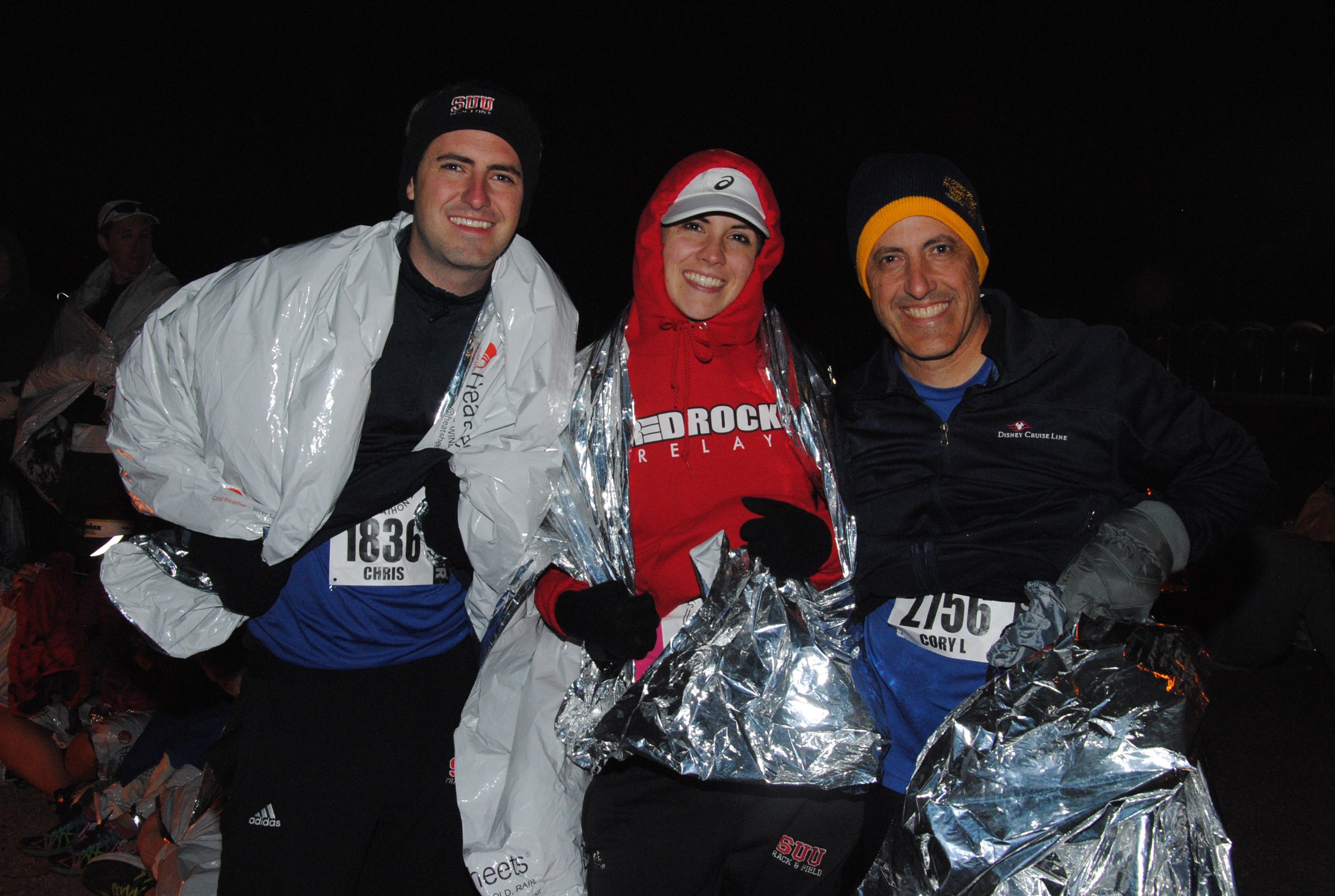
My biggest fear leading up to the marathon was making it the whole race without needing an emergency bathroom stop—which had never happened on a run over 13 miles—so I made two trips to the portable restrooms, and then a third after ditching my bag at the bag drop (good bye warm clothes!), but as I stood at the starting line I still felt like I had to go again. Oh, the things anxiety can do.
The race started without great fanfare. There was a distant gunshot which I thought might have been the start of the wheelchair participants, and then several minutes later the mass of thousands started to shuffle forward.
Nothing can match the euphoria of starting a race with a giant group of people and no other sound than that of a thousand pairs of shoes slapping the pavement. Your body is tapered, mind focused, legs fresh, and running has never felt so good. My goal was to finish in 4:30, so I’d settled myself into that pack, but as we crossed the starting line, I was already starting to get passed. (Except for the those few special souls who were already heaving at 100 meters in.) Since the first seven miles were downhill, and I desperately wanted to avoid the great tragedy of starting out too fast, I was religiously keeping my pace at 9:30. Christopher ran the first mile with me and my dad to be able to say we ran at least some of it together, and then he took off, and I wouldn’t see him again until the finish line. My dad planned to run with me the whole time to keep me company and offer moral support, but after the first couple of miles, I could tell that even he was itching to drop the pace.
“You know, Kimberly, you don’t have to run so slow that you’re braking on the hills,” he said at one point. “You can just kind of open up and let gravity do some of the work for you.”
I knew this, but I also knew that it was easy to get carried away on the downhill. Nevertheless, I felt bad making my dad go so slow, so I lengthened my stride and let the pace drop. As the miles clocked by at just under 9-minute miles, I started to worry that I was torching my race, but my legs felt good, so I decided to go with it.
My body had been reminding me since the start that it wanted to make a pit stop, and I was surprised at how many people had the same urge. People were darting off the road left and right, pulling down their pants and doing their business on the side of the road or behind the nearest bush. My dad shook his head and kind of laughed at them while I wondered if that would be me in a couple miles. I could understand their dilemma. There were portable restrooms provided every mile of the course, but four portable restrooms couldn’t handle the mass of bathroom emergencies stampeding down the canyon, and most people weren’t going to wait in the long lines at every pit stop.
While my pace quickened and the miles stretched on, I kept my eyes peeled for an opportunity to take care of my business that didn’t require waiting in line. At mile 7, the opportunity presented itself: two vacant portable restrooms and no line. Hallelujah. I told my dad I needed to stop, ran straight to a vacant stall, and got it done in less than thirty seconds, sacrificing a chunk of my arm to the toilet paper holder in the process. It bled the rest of the race, and now I have a battle scar to remember my first marathon. Classy.
With my biggest fear out of the way, it was time to tackle the next biggest obstacle of the race—Veyo hill. My training consisted of lots of gradual inclines, but all attempts to train on steeper terrains gave me hip pain, so I wasn’t sure how I’d do on Veyo. I expected my pace to slow—a lot—but I knew the second half of the race would be all downhill so I could make up the time later.
The hill itself was steep, as promised, but it was over in a few short minutes without much difficulty. The real challenge came later. I had diligently studied the course map and knew there was a bit of climbing to do before the downhill sailing to the finish line, but the incline was much steeper than I expected, and it didn’t cease for four straight miles. Aerobically, my body felt great, but the angle of the pavement started to take a toll on ligaments that weren’t used to spending so much time on such a steep slope. The back of my right foot started to hurt, and though my muscles didn’t mind the climb, that little nagging spot begged for the crest of the hill and the relief that would come from level ground. At one aid station, a glorious volunteer stood waiting with icy hot already smeared on his gloved fingers which he applied to the troublesome area, and it helped a little, but the real relief came at mile 11 when the pavement finally leveled out.
With the hills behind me, I went back to noticing the scenery and the people that had come out to cheer on the marathoners. A lot of nearby residents had funny or inspirational signs, and they cheered for everyone that ran by. Also, by this point, the herd had started to thin, so I used other runners around me to gauge how I was doing. Was I breathing that hard? Did my form still look that relaxed? I was still able to keep up easy conversation with my dad, and my legs felt great, so I assumed that I was keeping a manageable pace.
At mile 14, the elevation really started to drop, and since I felt nearly as fresh as when I’d started, I decided it was time to push the pace. My half marathon time came in around 2:04, well under my goal pace, so now it was just going to be a question of how by how much.
Around mile 16, another hill appeared in the distance, far steeper than I expected based on the elevation map, but it was soon behind me.
“I thought they said last hill at mile 11,” I told my dad, and we laughed together. “I know that was the last one, though. For sure.”
Two miles later, we hit last hill number three, and along with it a surprise mid-mile aid station. Because it came a half mile early and was mid hill, I decided to skip it and not lose the momentum, which turned out to be a mistake. The rising sun and dropping elevation made it get warmer, fast, and hydration was starting to become more difficult. Once I realized that the mile 18.5 aid station was really the mile 19 aid station and that there wasn’t supposed to be another one until mile 21, I started to worry. Within a few minutes, I was looking at runners with jugs of dripping water with great longing, wondering if any of them would be willing to just let me squirt a little bit in my mouth. They had so much—12 maybe even16 ounces. They could spare a little, just to get me through to the next aid station. I fantasized about finding abandoned water bottles on the side of the road, and it didn’t matter whose they were or how many mouths they had touched, if I could just find one I could maybe, maybe quench my thirst.
At mile 20, I was met with the most magnificent surprise—an unadvertised aid station. I took my last GU, downed three cups of water, and vowed to never skip another aid station.
As I crossed the 20 mile mark, I waited every step for my legs to hit the wall as every step was in unchartered territory, farther than I’d ever run before. My hips ached and burned, but I was still accelerating, clocking in every mile under 9 minutes. There were a few more last hills, and at every one of them new muscles complained at the change in slope while old muscles sighed in relief. The miles started to drag slowly, and I had to remind myself how many miles were left so I didn’t accidentally get ahead on my count; that would have been devastating to my mental game.
At one point, we reached a turn where a bunch of spectators came to cheer for their family and friends. For the last five miles, I had planned to dedicate a mile to my husband and each of my children and think of only them for those miles, but once I saw those people with their signs, little children waving banners that said, “Go Daddy!” or “You can do it, Mommy!” my eyes filled with tears, the emotion closed off my lungs, and I knew I had to abandon that plan. The thought of my sweet husband and children being there at the finish line and all that they had sacrificed to let me train and run this race was overwhelming, and I had to push the thought away to be able to breathe. Just think of the pain, think of the pain, I told myself (which was not in the least bit difficult) until I could breathe again.
From then on, the miles dragged on. I only had room for one word in my head at a time. “Five. Five. Five. Five. Five. Five,” then “Four. Four. Four. Four. Four. Four.”
I was still dropping the pace, and my legs screamed for relief.
It would be nice to stop, I thought. Stopping would feel really, really, nice.
But my legs wouldn’t slow, couldn’t slow. Not even to walk at the aid stations. My muscles were torn to shreds, locked into a rhythm that couldn’t be stopped. Any minute, I thought they would spasm and I would collapse.
I knew it would hurt less if I slowed down. I could easily glide into the finish, well under my goal, if I would just ease off a little. But I had already come so far. I didn’t want to give up now, not when I was so close.
I checked my Garmin again and noticed I was steadily holding a sub-8:30 pace, and my projected finish time was fast-approaching 4 hours. I could still do math well enough to know I couldn’t go under 4 hours, but I was going to get annoyingly close. Such a shame.
At the mile 23 aid station, which came at mile 22.5, a kind volunteer cheered to all the runners, “Less than three miles to go! You’re almost there!”
My analytical, mathematical mind that had adamantly relied on a Garmin for every run of my training knew that she was way off, and I wanted to tell the other runners that we still had 3.7 to go, but I decided to let them have false hope. It was all about tunnel vision now. Get to the finish. Get there as quick as possible.
With 2.2 miles to go, I needed to reset my mind and refocus, so I forced my legs into a reluctant walk while I downed a cup of Gatorade. For the last few miles, it seemed my dad had been in good spirits, warmly thanking the volunteers, waving, smiling, and I wondered if he felt any of the pain I did. All I could do was grunt at the person handing me the paper cups and barely lift my eyes at the those who cheered for me by name.
At mile 24.5, my brain forgot how to do second grade math and instead of adding that annoying little .2 when calculating my distance remaining, I subtracted.
Only 1.3, I thought. I can push a little harder for just 1.3.
I turned up the speed and started to kick it in, turning corner after corner of the St. George streets, begging for the end. After I ran what I felt was another quarter mile, I checked my Garmin and was devastated to see 1.5 miles left.
What?!
If there was ever a time I hit the wall in this race, that was it. I abandoned my quickened pace, with no other thought than to just make it to the finish line. Alive.
Will this race ever end?
With one mile left I persuaded myself to pick up the pace again, knowing I had run a great race this far. It would be a shame to give up with only one mile left.
When I rounded the last corner and the finish line came into view, my eyes swept the stands for my family, and when I found them, I had to choke back tears again. They were there for me, here, supporting my crazy running hobby yet again. As far as I was concerned, I had made it. The finish line was only a few steps away. Relief was only a few steps away. It didn’t even bother me at all that someone outkicked me those last few steps.
As I crossed the finish line at 4:02:16 with my dad by my side, he patted me on the back and said, “You did it, Kimberly.” It hardly seemed real.
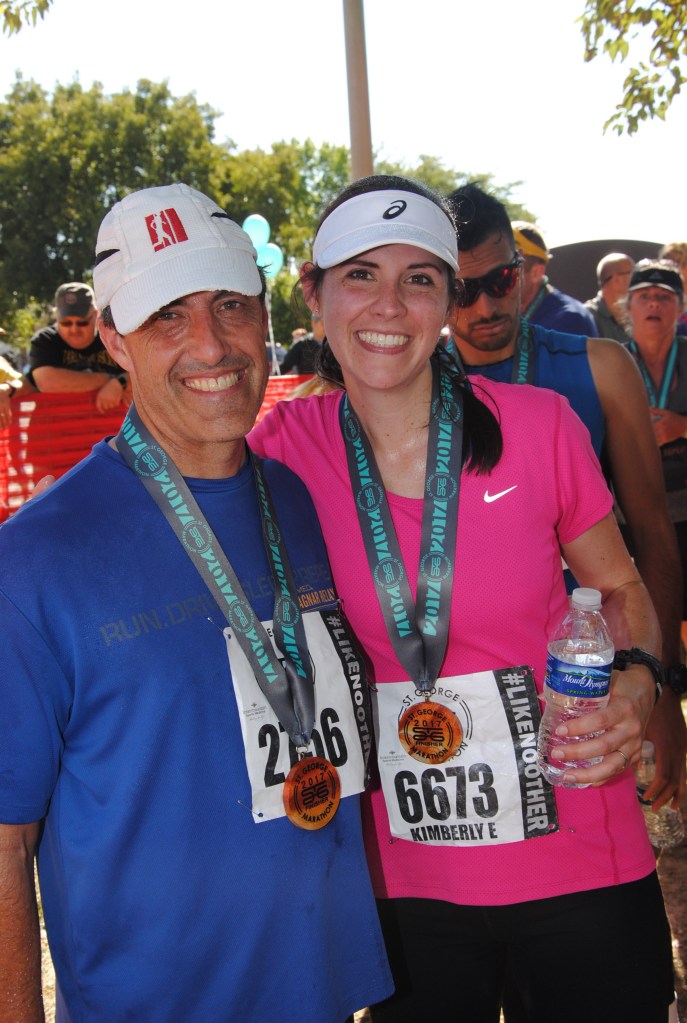
I downed the cup of water that someone handed me and then half of the water bottle someone else handed me, got my picture taken with my dad with our finisher medals, and barely made it out of the finish chute before the nausea hit, taking me completely by surprise. Too dizzy to stand or even sit up, I lay in the runner’s corral for several minutes. As ridiculous as it was, I eventually just decided to crawl my way out toward the exit because I wanted to see my family, and I knew the nausea wasn’t going to pass anytime soon. I found them in a field just outside the corral and I was finally able to I embrace my husband, my children, and my mom.
“So would you do it again?” my mom asked.
I scoffed and gave a small laugh. “Ask me later.”
The real answer was of course, yes. I wanted to see if I could do it again, only next time, faster. A fire had been lit within me, and this was just the beginning.
 K. Z. Richards
Leave a comment